

Salts Gone® vs Vinegar - Why DIY Salt Removal Falls Short
Vinegar is the most popular DIY salt remover on the internet — but acetic acid dissolves more than just salt. Learn why a pH-neutral chelation formula outperforms the home remedy without risking damage to your paint, metal, chrome, or rubber.
Salts Gone® vs Vinegar — Feature by Feature
Compare professional chelation technology against the most common DIY salt removal method across every metric that matters.
Vinegar vs Salts Gone® for Salt Removal — What Actually Works
Can You Really Remove Salt with Vinegar?
It is one of the most searched questions every winter: can vinegar remove salt? The short answer is yes — vinegar’s acetic acid can dissolve visible salt crystals on contact. That is why thousands of blog posts and YouTube videos recommend a vinegar-water solution for cleaning salt stains from cars, boots, and driveways. And for surface-level salt stains on non-metal items, it works well enough.
But there is a critical difference between dissolving visible white salt residue and actually removing salt ions that have bonded to metal, paint, and rubber at a molecular level. When sodium chloride, calcium chloride, or magnesium chloride contact your vehicle’s surfaces, the salt dissociates into individual ions that embed themselves into microscopic pores in metal and beneath clear coat. Vinegar can dissolve the crystallized salt you see, but it does not address the ions you cannot see — the ones actively causing corrosion beneath the surface. Salts Gone® uses chelation technology to capture those embedded ions, permanently break the ionic bond, and remove them entirely. That is the difference between cleaning a salt stain and actually stopping corrosion.
The pH Problem: Why Acid Is Not the Answer
White distilled vinegar has a pH between 2.4 and 3.4, making it a moderately strong acid. That acidity is what gives vinegar its cleaning power — but it is also what makes it dangerous for vehicles, boats, equipment, and any surface with metal or protective coatings.
Acetic acid reacts with aluminum, producing aluminum acetate and hydrogen gas. This reaction visibly pits and corrodes aluminum wheels, trim, engine components, and trailer frames. On automotive clear coat, repeated vinegar exposure weakens the resin matrix, leading to clouding, hazing, and premature clear coat failure. Chrome plating is particularly vulnerable — acid eats through the thin chromium layer, causing irreversible pitting and dullness. Rubber seals, gaskets, and weatherstripping can swell, crack, and lose elasticity when exposed to acidic solutions over time. Electrical connections and terminals are also at risk, as acid accelerates oxidation on copper and tin contacts.
Salts Gone® is pH-neutral at 7.0. It removes salt through chelation chemistry rather than acid dissolution, which means zero risk to paint, clear coat, aluminum, chrome, rubber, plastics, glass, or electrical components. You get complete salt removal without trading one form of damage for another.
What Vinegar Actually Does (and Doesn’t Do)
Vinegar is reasonably effective at dissolving sodium chloride — ordinary table salt — because NaCl crystals dissolve readily in acidic aqueous solutions. If the only salt on your vehicle were NaCl in crystallized form sitting on the surface, vinegar would be a passable solution.
The problem is that modern road treatment uses far more than table salt. Departments of transportation across North America now rely heavily on calcium chloride (CaCl₂) and magnesium chloride (MgCl₂) brine solutions because they are effective at lower temperatures and adhere better to road surfaces. These divalent salts form stronger ionic bonds with metal surfaces than sodium chloride does. When CaCl₂ or MgCl₂ contact your vehicle’s undercarriage, the calcium and magnesium ions bond directly to metal at the molecular level.
Acetic acid can dissolve the visible crystal, but it does not chelate the calcium and magnesium ions themselves. Those ions remain on the surface after the vinegar evaporates, and they re-bond to the metal — continuing the corrosion cycle. This is why vehicles treated with vinegar still develop rust in the same areas. The visible salt is gone, but the corrosive ions were never actually removed. Salts Gone’s® chelating agents bond to calcium, magnesium, sodium, and chloride ions individually, encapsulating them so they cannot re-bond to any surface. The ions are lifted off and rinsed away permanently.
The Hidden Costs of the “Free” Solution
Vinegar costs a few dollars per gallon, making it seem like the obvious budget choice compared to a purpose-built salt removal product. But the true cost of using vinegar on vehicles and equipment includes far more than the price of the bottle.
Surface damage accumulates over time. Clear coat repair on a single panel costs $150 to $400. Chrome wheel restoration runs $100 to $200 per wheel. Replacing dried and cracked rubber weatherstripping on a vehicle can cost $200 to $600 depending on the make and model. Corroded aluminum trim replacement on trucks and SUVs frequently exceeds $500.
Without a corrosion-inhibiting barrier, vinegar-treated surfaces are immediately vulnerable to new salt exposure. This means ongoing rust repair, more frequent undercoating applications, and accelerated depreciation. Vinegar also requires multiple applications and manual scrubbing to achieve even partial results, costing significant time and labor. And the strong, persistent vinegar smell draws complaints from family members, neighbors, and customers if you are running a commercial operation.
When you factor in the cumulative cost of surface repairs, lost vehicle value, additional labor, and the corrosion protection you are not getting, vinegar is one of the most expensive salt removal methods available.
When Vinegar Might Be Okay
In the interest of fairness, vinegar does have legitimate cleaning uses. It is fine for removing salt stains from rubber floor mats, tile and hardwood floors, concrete steps, and other non-metal indoor or household surfaces where acidity will not cause damage and corrosion protection is not needed. However, vinegar can damage fabrics and leather over time due to its acidity — Salts Gone® will not.
But for anything with automotive paint, clear coat, aluminum, chrome, stainless steel, rubber seals, or electronic components — vehicles, boats, trailers, aircraft, industrial equipment, outdoor furniture, HVAC systems — a pH-neutral chelation product is the only safe and effective choice. Salts Gone® removes all types of salt at the molecular level, leaves a corrosion-inhibiting protective barrier, and does it without risking a single surface on your vehicle or equipment.
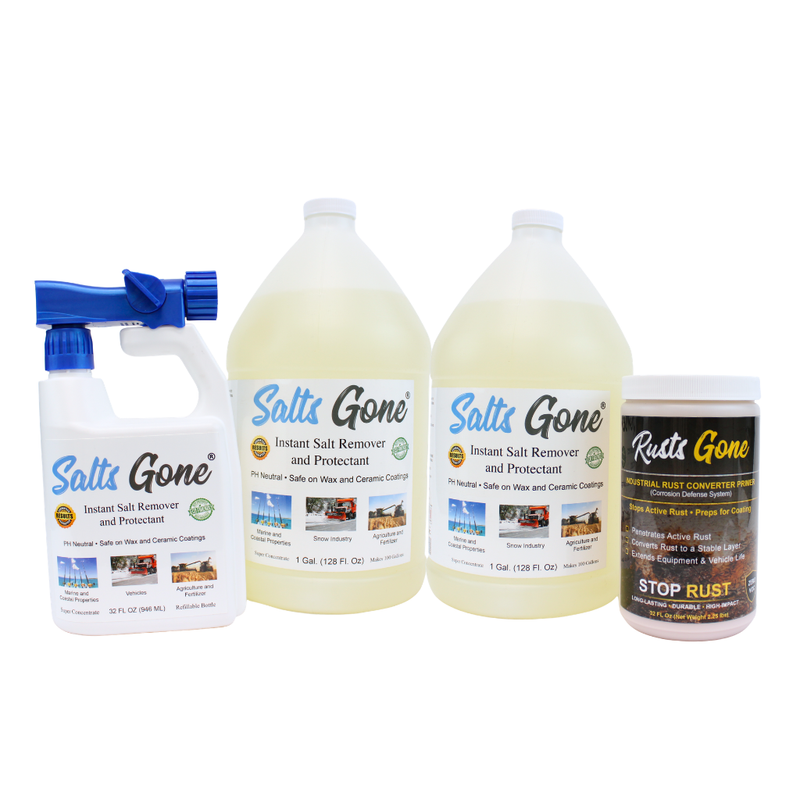
Stop Risking Damage with DIY Solutions
Professional chelation technology removes salt completely and safely — no acid, no surface damage, no lingering odor. See why professionals in aviation, marine, and fleet management trust Salts Gone® over any home remedy.
What Our Customers Say
Trusted by boaters, drivers, fleet operators, and homeowners across the country.
This is a must have if you live in the rust belt. I use it on my truck and tractor. It's amazing stuff.
As a coastal homeowner, we are finally able to efficiently protect our property from the corrosive environment around us.
I have been using Salts Gone on my boat and jet ski now for 2 years. Best product I have ever used. Way better than the competitors.
We use Salts Gone on our plow trucks after each snow event and are very happy with the results! Clean trucks with no salt residue left behind.
Best salt fighting product on the market. Honest advertisements unlike the competitor.
What a shocking experience! My pickup is not only showing no signs of salt, it is cleaner than it was before!


Common Questions About Vinegar and Salt Removal
Answers to the most frequently searched questions about using vinegar to remove salt from vehicles, metal, and equipment.